The Half-Life Trap: Why AI Training Programs Keep Graduating People Into Yesterday's Jobs
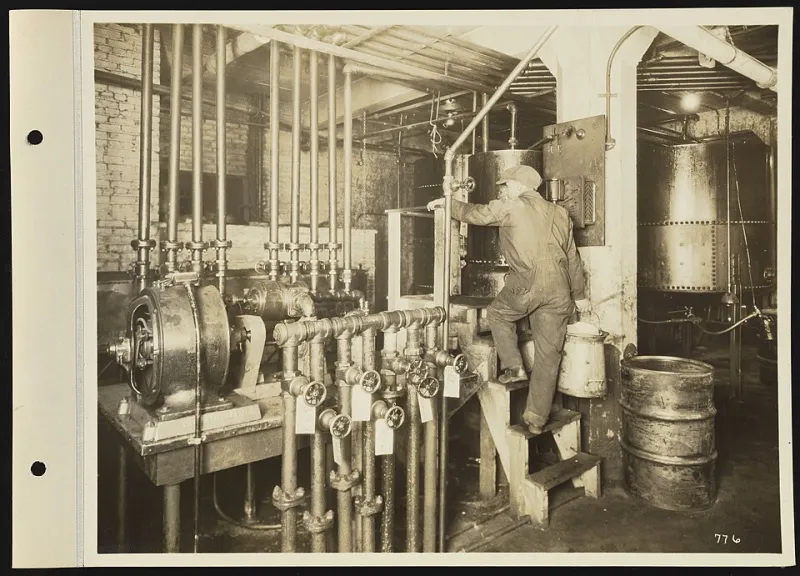
Photo: Dearborn Chemical Company, No restrictions, via Wikimedia Commons
The Certificates Are Valid. The Skills Are Not.
Walk through the learning and development pages of almost any large US employer and a pattern emerges. A catalog of courses organized around named products: prompt engineering for a specific assistant, workflow automation in a specific platform, analytics in a specific copilot. Completion rates are tracked. Badges are issued. Quarterly reports celebrate participation.
Then the vendor ships a new interface, the prompting techniques that dominated last year's curriculum become obsolete, and the organization discovers it has invested in familiarity rather than capability.
The half-life of tool-specific knowledge in AI has compressed to something measured in quarters. A reskilling program that requires six months to design, approve, and deliver is at risk of graduating its first cohort into workflows that have already been restructured. This is not a failure of effort. It is a failure of target selection.
Why Curriculum Lags by Design
Corporate training is a consensus product. It requires sign-off from learning teams, compliance, business unit leadership, and often procurement. Each gate adds delay. By the time a course on a specific platform reaches its audience, the platform has shipped three releases and the surrounding work has changed shape.
There is also a structural incentive problem. Certificates are countable. Improved judgment is not. Programs that report completions look successful in executive reviews even when the underlying capability has not moved, and the organizations that measure hours invested rather than decisions improved will keep funding the wrong thing.
What Actually Transfers
Durable capability in an AI-saturated workplace clusters around a small number of competencies that survive model turnover.
Evaluation judgment. The ability to look at generated output and determine whether it is adequate, where it fails, and why. This is the scarcest skill in most enterprises and the least commonly taught. It requires domain expertise, not tool familiarity.
Systems reasoning. Understanding how a workflow's steps depend on one another, where errors compound, and where a plausible-looking output can propagate into a consequential decision.
Data literacy at the point of use. Knowing what a system's inputs actually represent, and recognizing the difference between a metric that is available and a metric that is meaningful.
Framing and decomposition. Converting an ambiguous business problem into a set of tractable subproblems, some of which a machine can handle and some of which it should not.
Governance fluency. Understanding what evidence is required to defend a decision that was machine-assisted, and who carries the accountability when it goes wrong.
None of these expire with a release cycle. All of them require practice under supervision, which is why classroom delivery alone rarely produces them.
Apprenticeship, Not Announcement
The most effective programs observed in practice share an unglamorous trait: they are embedded in the work. A cohort does not learn about automation in the abstract. It takes a live process, documents the current state, identifies the steps where machine assistance is appropriate, builds the change, measures the effect, and documents what failed.
That structure produces three outputs at once: a trained person, a measurable workflow improvement, and a reusable case study that the next cohort inherits. It also produces something a certificate cannot, which is calibrated confidence, including a clear sense of where the tool should not be trusted.
The role of the learning function shifts accordingly, from content delivery to the design of supervised practice. This is harder to administer and considerably harder to fake.
A Framework That Ages Gracefully
Map Workflows, Not Job Titles
Job titles obscure where automation actually lands. A single title may contain fifteen tasks, three of which are highly automatable and twelve of which require judgment that no current system reproduces well. Training should target tasks.
Define Outcomes Before Content
For each cohort, specify the observable change expected in the workflow: cycle time on a specific process, error rate on a specific review step, volume of escalations. If no such measure can be named, the program is not ready to launch.
Maintain a Capability Ledger
Track demonstrated competencies with evidence, not attendance. A record that someone has evaluated two hundred model outputs against a rubric and had their disagreements reviewed is worth more than a completed module.
Build the Review Muscle Into the Flow
Pair every deployment with a structured review routine in which practitioners examine machine output and discuss discrepancies. This is where evaluation judgment forms, and it costs far less than a formal course.
Reassess on a Fixed Cadence
Revisit the curriculum every quarter against what the deployed tools actually do now. Assume a portion of the content is already stale and plan to retire it.
The Honest Version of the Promise
Reskilling is often sold internally as protection against displacement. The more accurate framing is that it buys optionality. People who can evaluate machine output, reason about system behavior, and defend a decision with evidence remain valuable even as the specific tools they learned are replaced.
The alternative, a growing library of credentials attesting to fluency with software that no longer exists, is an expensive way to document the gap between what an organization said about its workforce and what it actually built.