Beyond the Demo Stage: The Operating Habits That Separate Innovation Theaters from Real Product Engines
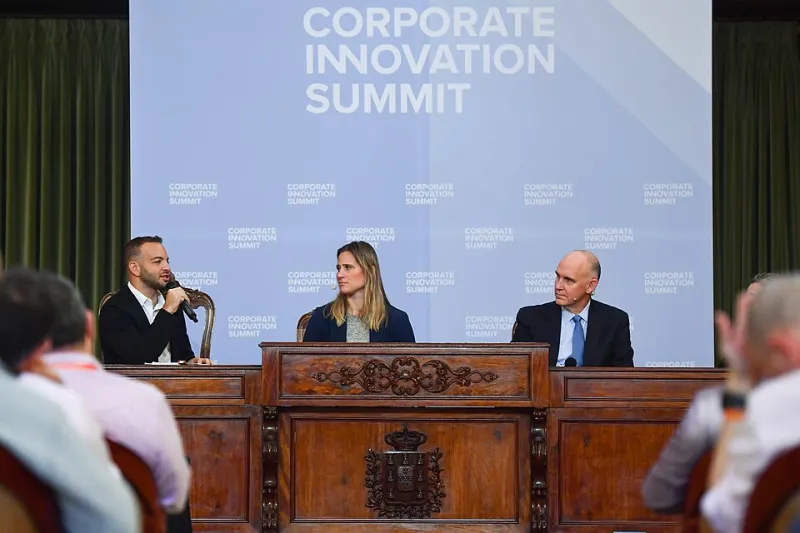
Photo: Web Summit, CC BY 2.0, via Wikimedia Commons
Walk the concourse of any tech conference in Austin, Las Vegas, or San Francisco and you will encounter them: glossy booths, holographic prototypes, sizzle reels from corporate innovation labs. And yet, ask which of these productions ever reached a paying customer, and the room goes quiet. The innovation lab has become a fixture of American corporate life — and, in most cases, an expensive one that never graduates past the demo.
The labs that do ship are not luckier or better funded. They behave differently. Five habits, observed consistently across labs that produce market-ready products, are worth studying.
1. They Measure Survival, Not Applause
Thesaurus Labs that fail almost always measure the wrong thing: patents filed, press mentions, hackathon placements. Labs that ship measure how long their projects survive contact with the market — retention, revenue, repeat usage. One practical implementation: replace the annual showcase with a quarterly 'graduation review' where every project must present live usage data or face sunset. What gets celebrated gets repeated.
2. They Rotate Talent Back Into the Core
Innovation labs that wall themselves off from the operating business become museums of what the company might have done. The highest-performing labs treat assignments as tours of duty: engineers and product leaders join for eighteen to twenty-four months, then return to the core carrying new methods with them. This does double work — it prevents the lab from becoming a career cul-de-sac, and it seeds transformation across the enterprise rather than concentrating it in a glass tower.
3. They Ship Ugly, Early, and to Real Users
The demo is the enemy of the product. Demos are rehearsed, curated, and friction-free; products are none of those things. Labs that ship put unfinished tools in front of actual customers within weeks, accepting embarrassment as the price of learning. A useful rule: no prototype may be presented externally — including internally to executives — until three unrelated users have attempted a real task with it and failed at something.
4. They Have a Kill Discipline
Most labs keep zombie projects alive because killing them feels like admitting failure. Shipping labs institutionalize the opposite. They set explicit sunset criteria at inception — usage thresholds, cost ceilings, time limits — and honor them without ceremony. The counterintuitive result: teams stop defending dead ideas and start generating new ones, because failure is cheap, fast, and career-safe.
5. They Own a P&L, Even a Small One
Nothing changes behavior faster than accountability for margin. Labs that ship eventually inherit a small profit-and-loss responsibility — even a modest one — that forces trade-offs between ambition and economics. The demo theater never has to ask what something costs to run; the product engine asks every day.
The Deeper Pattern
Notice what these habits have in common: each one replaces a symbolic reward with a market consequence. Innovation theater thrives wherever applause substitutes for outcomes. Transformation succeeds wherever reality, in the form of users, revenue, and sunset clauses, is allowed to vote.
For American enterprises spending billions annually on innovation infrastructure, the prescription is uncomfortable but simple. Stop funding showcases. Start funding survival — and reward the lab not for what it imagines, but for what it delivers.